
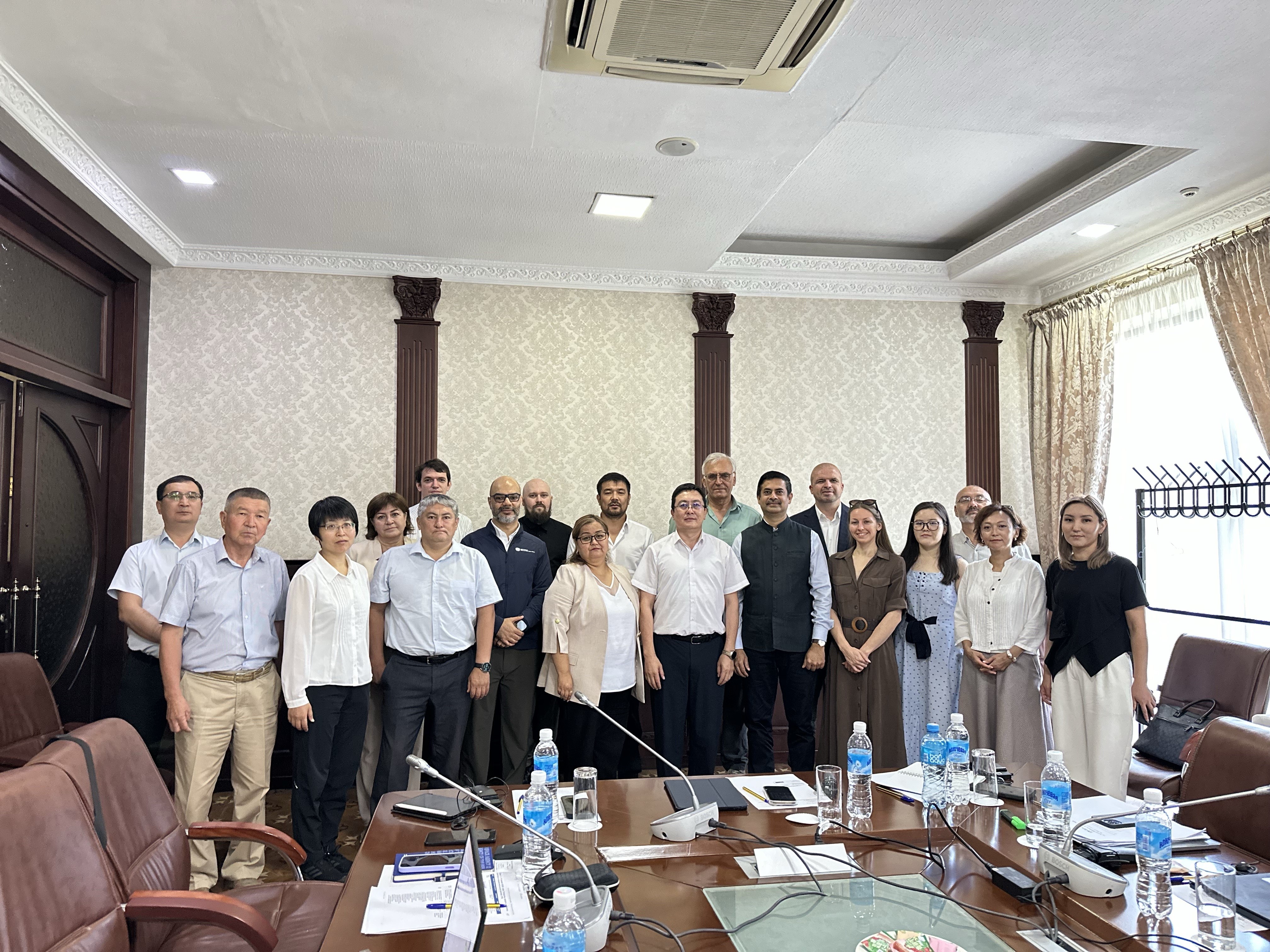
UN-SPIDER COMMENCES TECHNICAL ADVISORY MISSION TO KYRGYZ REPUBLIC — A STRATEGIC ASSESSMENT TO STRENGTHEN NATIONAL DISASTER RISK MANAGEMENT USING SPACE-BASED INFORMATION
Bishkek, 8 July 2026 — The United Nations Platform for Space-based Information for Disaster Management and Emergency Response (UN-SPIDER) Beijing Office, today commenced its three-day Technical Advisory Mission (TAM) to the Kyrgyz Republic, hosted by the Ministry of Emergency Situations (MES KR), in Bishkek.
This mission scheduled for 8–10 July 2026 is a targeted, collaborative, and results-oriented assessment designed to evaluate and strengthen the Kyrgyz Republic’s national capacity to leverage space-based information for disaster risk management (DRM), emergency response, and climate resilience.
The mission will be led by Dr. Hamid Mehmood, Head of the UN-SPIDER Beijing Office, in close coordination with Mr. Karybai uulu Kanat, Head of the International Cooperation Department, Ministry of Emergency Situations of the Kyrgyz Republic.
The mission will be structured around the UN-IGIF-adapted Strategic Pathways Framework, which organizes the national assessment across nine key areas:
• Governance — Clarification of mandates, coordination mechanisms, legal frameworks, and financing
• Technology — Review of data, satellite supply chains, geospatial infrastructure, interoperability, and operational workflows
• People — Assessment of partnerships, capacity development, user engagement, and sustainable human capital
• Country — Priorities related to hazards including floods, mudflows, landslides, avalanches, earthquakes, droughts, and glacial lake outburst floods
The mission will engage key technical agencies, including Kyrgyzhydromet, the Institute of Seismology, the Ministry of Water Resources, the National Geodetic and Cartographic Service, and the Ministry of Education and Science along with civil society partners and national stakeholders to conduct a comprehensive, institutional, and operational assessment.
Key deliverables include:
• A validated institutional and stakeholder mapping for space-based DRM
• A summary assessment of strengths, gaps, and needs across the nine strategic pathways
• Prioritized recommendations organized into short-term (0–1 year), medium-term (1–3 years), and long-term (3–5 years) actions
• A concise, actionable national action plan to support UN-SPIDER follow-up and inform the Kyrgyz Republic’s broader IGIF Country-Level Action Plan and national geospatial development strategy
The mission will conclude with a final debrief session with senior national officials and a formal report to be shared with national counterparts and the UN-SPIDER community.
The Kyrgyz Republic Government has demonstrated strong commitment to this mission to ensure a seamless and productive engagement.
“Space-based information is not a luxury it is a necessity for national resilience,” said Dr. Hamid Mehmood. “This mission is not just about assessment it is about building a roadmap for the Kyrgyz Republic to become a leading user of space data for disaster preparedness and emergency response.”
The UN-SPIDER Technical Advisory Mission is a vital part of the global effort to strengthen national systems for disaster risk reduction powered by space.
