
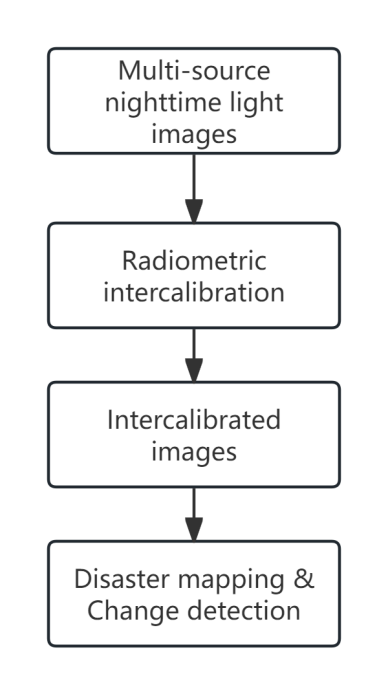
The objective of this practice is to provide a radiometric intercalibration method for integrating multi-source nighttime light images in disaster scenarios. This method can be used by disaster management agencies and other stakeholders to improve comparability of nighttime light images, thereby supporting rapid disaster assessment, emergency response, and post-disaster recovery monitoring in affected areas.
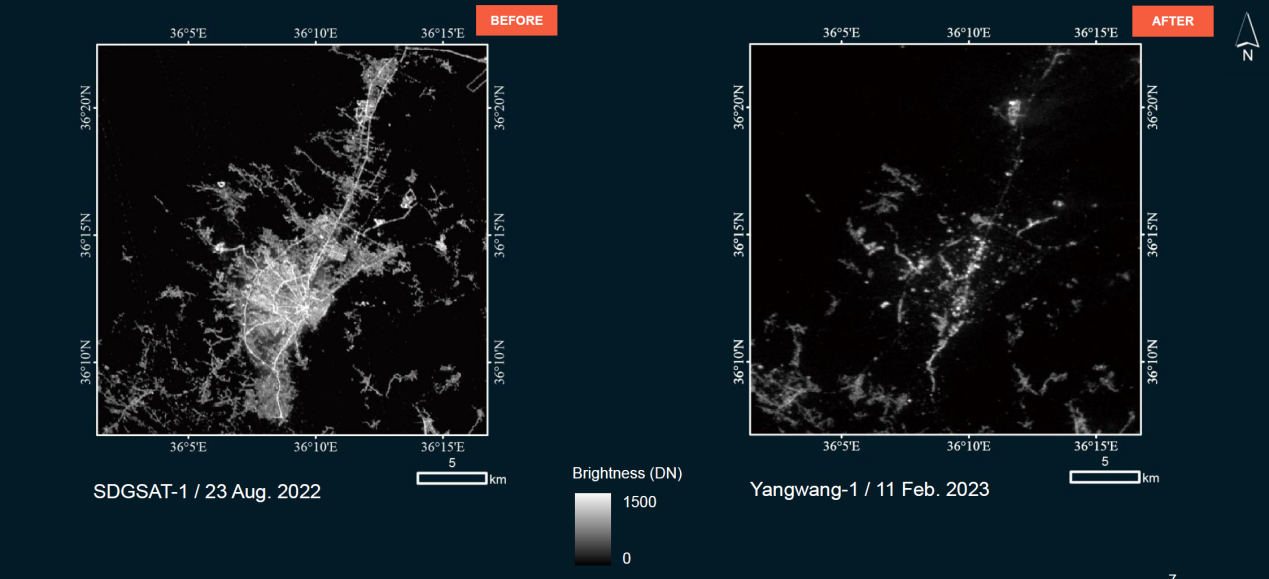
The Recommended Practice was initially applied to the Turkey–Syria Earthquake using nighttime light images from SDGSAT-1 and Yangwang-1 as examples. SDGSAT-1 is an Earth observation satellite developed by the International Research Center of Big Data for Sustainable Development Goals (CBAS) to support the United Nations Sustainable Development Goals, and its glimmer imager (GLI) provides multi-color nighttime light observations including RGB bands with a spatial resolution of approximately 40 meters. Yangwang-1 is developed by Origin Space Corporation in China that provides panchromatic nighttime light imagery with a spatial resolution of approximately 38 meters.
For the analysis, the SDGSAT-1 and Yangwang-1 images were clipped to the area of interest (AOI) covering the disaster region and resampled to the spatial resolution of Yangwang-1 to ensure spatial consistency between the datasets. Using these two sensors as an example, this practice demonstrates a technically robust radiometric intercalibration workflow that can generate radiometrically consistent nighttime light imagery. The workflow is designed to be transferable and can be applied to the intercalibration of other high-resolution nighttime light datasets from different sensors.
Related Data:
- SDGSAT-1 (CBAS)
- Yangwang-1 (Origin Space Corporation in China)
Wuhan University contact:
Dr. Xi Li
Professor, State Key Laboratory of Information Engineering in Surveying, Mapping and Remote Sensing , Wuhan University
Deputy Director, Office of International Affairs, Wuhan University
Research team Webpage: http://nightlight.whu.edu.cn/en
Head, China Regional Support Office, UN-SPIDER
Lead of GEO Initiative - GEO Night Light, Group on Earth Observations
E-mail: li_rs [at] 163.com (li_rs[at]163[dot]com), lixi [at] whu.edu.cn (lixi[at]whu[dot]edu[dot]cn)
This practice can be applied to disaster events anywhere in the world.