
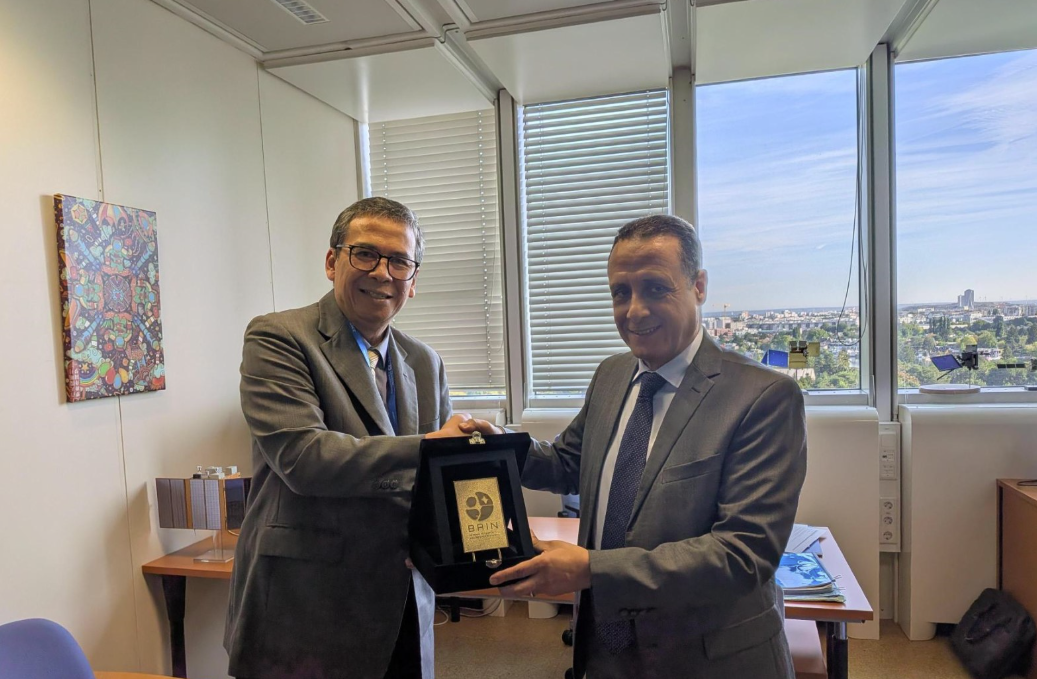
Vienna, Austria, 18 September 2026 – The United Nations Office for Outer Space Affairs (UNOOSA), through its UN-SPIDER programme, welcomed a delegation from Indonesia's National Research and Innovation Agency (BRIN) to the Vienna International Centre to discuss the renewed partnership between the two organizations and explore opportunities for enhanced collaboration in disaster risk reduction and resilience.
The BRIN delegation was led by Mr. Nunung Nuryartono, Deputy Chairman for Development Policy, and included Mr. Dimas Irawan, Executive Director of the International Nuclear Energy Agency of Indonesia, BRIN, Dr. Eka Djatnika Nugraha, Science Attaché of the Permanent Mission of Indonesia in Vienna, and Ms. Mashita Insani Kamilia, First Secretary of the Permanent Mission of Indonesia in Vienna. Representing UNOOSA were Driss El Hadani, Deputy Director of UNOOSA, Muhammad Sheraz Ahsan, GIS and Remote Sensing Expert with UN-SPIDER, and Jumpei Takami, Associate Expert in Remote Sensing for Disaster Management with UN-SPIDER.
The original Memorandum of Understanding (MoU) was signed in 2013 following the renewal of the MoU between UNOOSA and BRIN in August 2026. The meeting marked an important milestone to reinforcing BRIN's role as a UN-SPIDER Regional Support Office (RSO) for Indonesia. The renewed agreement provides a framework for cooperation over the next three years, focusing on capacity-building, the use of space-based information, and disaster risk reduction activities.
During the discussions, Mr. Nunung Nuryartono expressed his appreciation for the long-standing cooperation between UNOOSA and BRIN, highlighting the value of the partnership in supporting Indonesia's efforts to strengthen the use of space technology and Earth observation applications for disaster management.
Driss El Hadani emphasized the growing importance of space-based information and digital technologies in supporting evidence-based decision-making. He noted that satellite data, space technology, and digital tools provide critical support for disaster resilience, emergency response, recovery, and rehabilitation efforts. He also highlighted the importance of strengthening national capacities in space law and policy and encouraged BRIN's participation in upcoming global space activities organized by UNOOSA, including events to be held in Bangkok.
The meeting also reviewed the response to the Flores earthquake of August 2026, during which BRIN served as Project Manager under the International Charter: Space and Major Disasters. As a UN-SPIDER Regional Support Office, BRIN coordinated satellite-based response efforts in collaboration with national and international partners. UN-SPIDER complemented these efforts by facilitating access to additional satellite imagery covering affected areas beyond the initial Charter Area of Interest, helping improve situational awareness for disaster response authorities.
Participants discussed lessons learned from the Flores earthquake response, including the importance of access to pre-event satellite imagery, comprehensive coverage of affected areas, and strengthened mechanisms for rapid damage assessment. These experiences underscored the value of sustained cooperation among institutions involved in satellite-supported disaster management.
Building on these lessons, UNOOSA presented a project concept currently under development on coastal disaster resilience and maritime safety Indonesia. The proposed initiative would promote the use of space technologies, including satellite imagery, artificial intelligence applications, and digital solutions to support multi-hazard risk assessments and enhance preparedness in coastal regions. UNOOSA also highlighted the potential for extending cooperation through innovative technologies such as the Internet of Things (IoT) and AI analystics to support disaster resilience efforts.
As part of the exchange, both organizations explored opportunities for BRIN's involvement in the proposed project and discussed avenues for future collaboration in Earth observation, disaster response, capacity-building, and research activities.
The meeting concluded with a reaffirmation of the strong partnership between UNOOSA and BRIN and a shared commitment to further advancing the use of space-based technologies for sustainable development and disaster risk reduction in Indonesia and the wider region.
As a symbol of the longstanding friendship and cooperation between the two organizations, the BRIN delegation presented a commemorative souvenir to UNOOSA Deputy Director Driss El Hadani at the conclusion of the meeting.
