
During the AI for Good Global Summit 2026 held in Geneva, Switzerland, from 7 to 10 July, the United Nations Office for Outer Space Affairs (UNOOSA), through its UN-SPIDER programme, actively contributed to the global framework on operationalizing artificial intelligence for multi-hazard disaster resilience. Across two specialized technical workshops on 7 July, UN-SPIDER presented scalable, concrete methodologies designed to transition cutting-edge machine learning research into sustainable national capabilities.
Translating Science and Standards into Public Trust
The morning session, “AI in Disaster Resilience: Bridging Science, Standards and Innovation”—organized by the International Telecommunication Union (ITU) Global Initiative on Resilience to Natural Hazards through AI Solutions—convened senior representatives from the World Meteorological Organization (WMO), ECMWF, UN-Habitat, and the UN Office for Disaster Risk Reduction (UNDRR). Discussions centered on the technical requirements for deploying usable, reliable, and standardized AI systems that governments and emergency responders can trust.
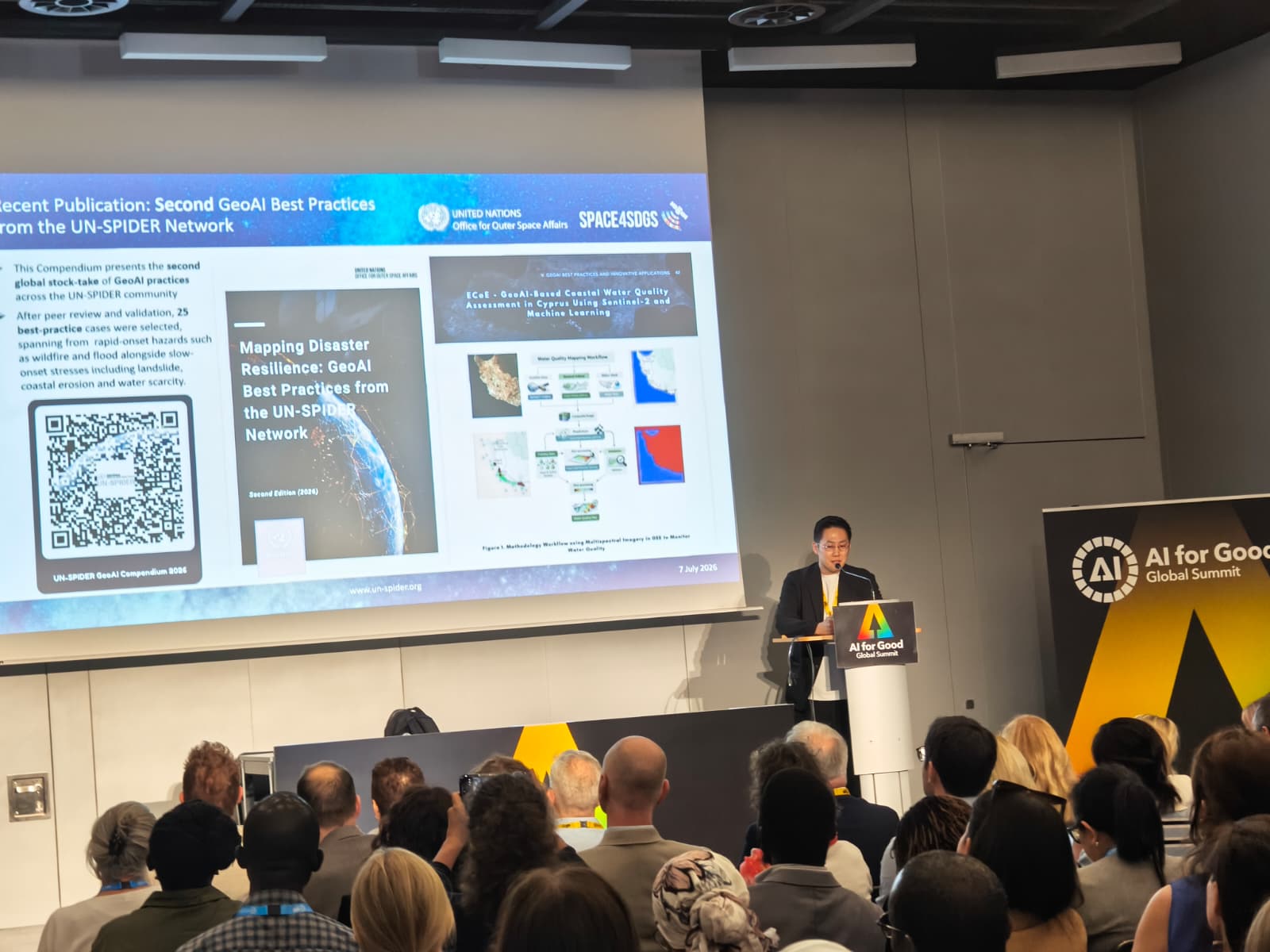
A core challenge articulated by UN-SPIDER is regional data scarcity. Many vulnerable regions, particularly Small Island Developing States (SIDS), lack baseline building footprint datasets and structural height descriptions essential for exposure modeling. To address this coordination gap, UN-SPIDER officially presented its GeoAI Compendium (2nd Edition, 2026). This publication features 25 global use cases demonstrating how machine learning can be used to successfully map both rapid-onset hazards like floods and wildfires and slow-onset stresses. The workshop also coincided with the announcement of a new international AI challenge focusing on short-term drought prediction.
Applied AI for the Early Warnings for All (EW4All) Initiative
The afternoon session turned toward concrete country applications during the workshop “AI for Early Warnings for All: From Innovation to Impact,” hosted by the AI Group of the EW4All initiative. The event served as the official launch pad for two landmark global resources: the AI Solutions Catalogue and the multi-agency report, "Leveraging AI to Enhance Multi-Hazard Early Warning Systems (MHEWS): A practical resource to support Early Warnings for All."
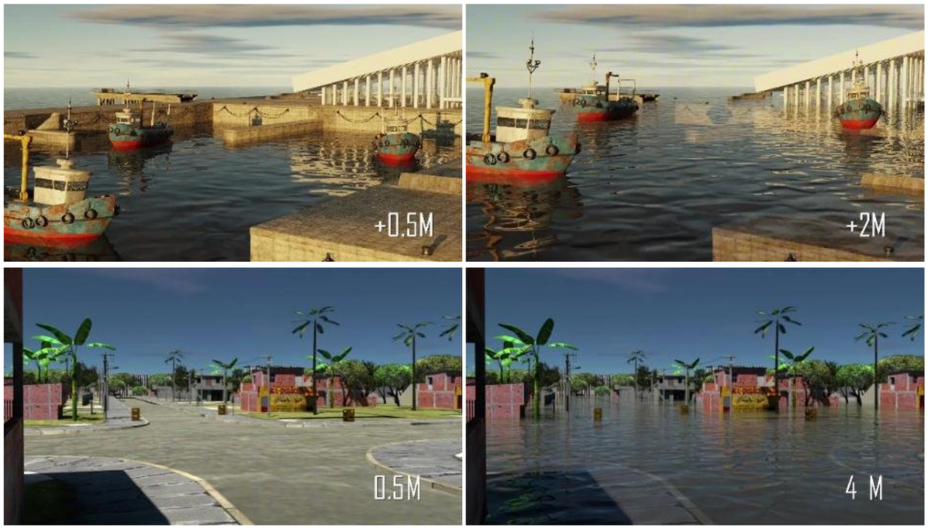
The flagship report explores how artificial intelligence can optimize the entire multi-hazard early warning value cycle, spanning hazard detection, automated data fusion, and targeted last-mile communication. As part of the session's Country Pilot Deep Dives, UN-SPIDER delivered an end-to-end demonstration of the Tonga Disaster Preparedness Platform. Developed as a cost-effective alternative to aerial drone surveys, the platform utilizes advanced deep learning and 3D computer graphics models (such as NeRF and Gaussian Splatting) on high-resolution 30cm satellite imagery to automatically extract building footprints and construct high-fidelity digital twins. By integrating real-world environmental data, the system allows local decision-makers to simulate predictive flood scenarios and generate dynamically optimized evacuation routes.
Strategic Horizons
The technical consensus from the summit underscored that artificial intelligence can be deployed effectively when embedded directly into existing institutional workflows, governed by strong human oversight, and backed by long-term investment in data infrastructure. Building on the momentum generated in Geneva, UN-SPIDER is actively scaling these frameworks into localized capabilities. Throughout the remainder of 2026, the programme will implement new digital twin, population mapping, and crop classification pilots to strengthen resilience frameworks within the Cook Islands, Palau, Ghana, Nigeria, Afghanistan, and The Gambia.
The second edition of the GeoAI Compendium is now available on the UN-SPIDER Knowledge Portal. The joint EW4All report, "Leveraging AI to Enhance Multi-Hazard Early Warning Systems," is accessible via the ITU Publication Hub.
Link for GeoAI compendium(Second edition, 2026): https://un-spider.org/about/mapping-disaster-resilience-second-edition-2026
Link for the joint EW4AII report: https://www.itu.int/en/ITU-D/Emergency-Telecommunications/Pages/Publications/ai-ew4all-report.aspx
Logo Credit: International Telecommunication Union (ITU) / AI for Good
