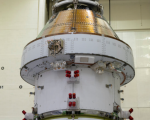
Last week, NASA launched its Space Launch System rocket from Kennedy Space Center in Florida, carrying four astronauts aboard the Orion spacecraft as part of the Artemis II mission. A central component of the mission is ESA’s European Service Module, which provides propulsion, electrical power, and life-support functions for the spacecraft and its crew during their journey around the Moon and back to Earth.
The African Association for Geospatial Development (AGEOS) is a non-profit organization established to promote the use of geospatial technologies, Earth Observation (EO), and GeoAI for sustainable development.
The African Association for Geospatial Development (AGEOS) is a non-profit organization established to promote the use of geospatial technologies, Earth Observation (EO), and GeoAI for sustainable development.
Based in Tunisia, AGEOS operates at regional and international levels, collaborating with academic institutions, governmental bodies, international organizations, and private sector partners. Its scope includes capacity building, applied research, innovation, and operational support in areas such as climate change adaptation, environmental monitoring, and risk management.
As a UN-SPIDER Regional Support Office, AGEOS contributes to strengthening the use of space-based information for disaster management in North Africa and beyond.
AGEOS brings specialized expertise in disaster risk contexts by leveraging Earth Observation, GeoAI, and advanced spatial analysis to support risk assessment, exposure mapping, and vulnerability analysis.
The organization develops operational tools for anticipatory action and early warning, including satellite-based environmental monitoring, near-real-time dashboards, and trigger-based systems for climate-related hazards such as floods, droughts, wildfires, and coastal erosion.
AGEOS integrates Digital Twins, 3D modelling, BIM, and UAV-based data acquisition to enhance infrastructure resilience, urban risk analysis, and disaster preparedness. It also contributes to multi-hazard risk analysis, including environmental pollution and waste-related risks, and promotes community-based approaches through participatory mapping.
Overall, AGEOS positions space-based technologies and geospatial intelligence as key enablers of evidence-based decision-making across the full disaster management cycle: prevention, preparedness, response, and recovery.
AGEOS leverages a wide range of open and institutional geospatial datasets, including satellite imagery, drone-based data for high-resolution mapping, open databases such as OpenStreetMap and national datasets, as well as environmental and climate data (land use/land cover, water resources, waste mapping) and participatory mapping data collected through community engagement. These datasets are processed, analyzed, and integrated by AGEOS into decision-support tools and platforms.
AGEOS has strong experience in designing and delivering capacity-building programmes targeting institutions, professionals, and youth. Its activities include:
Organization of training workshops on GIS, Earth Observation, and GeoAI
Development of training modules tailored to climate resilience and geomatics for environment
Implementation of hands-on learning approaches (hackathons, GeoLabs, project-based learning)
Capacity strengthening of local authorities, municipalities, and civil protection actors
Awareness programmes in schools and communities using participatory mapping
Support for integrating geospatial tools into public decision-making processes
Focal Point Pr. Nesrine Chehata nesrine.chehata [at] ageos.org (nesrine[dot]chehata[at]ageos[dot]org)
Alternative Focal Point Pr. Hedia Chakroun hedia.chakroun [at] ageos.org (hedia[dot]chakroun[at]ageos[dot]org)
Address Cité des sciences Rue de la cite des sciences à Tunis 1082 Tunis, Tunisia info [at] ageos.org (info[at]ageos[dot]org)
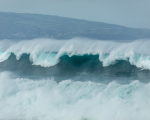
A powerful earthquake off Russia’s Kamchatka Peninsula in July 2025 has provided scientists with new observations of how tsunamis form near their source. Using data from a new generation satellite, researchers identified wave patterns that had previously been difficult to detect, offering additional detail on how undersea earthquake activity leads to tsunami formation.
This is event is available for participation on an ongoing basis
Join the Global Flood Partnership May 2026 Webinar Series "Advancing Global Flood Mapping with Earth Observation"! This event will feature three exciting presentations from distinguished experts in the field, focusing on Earth Observation data.
This is event is available for participation on an ongoing basis
Introduction
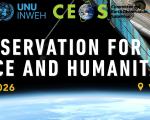
The Earth Observation (EO) for Resilience and Humanitarian Aid Training Programme is an intensive five-day hybrid course designed to strengthen the ability of UN personnel to use geospatial and satellite-derived information in operational, programmatic, and emergency-response settings. Taking place at the United Nations Office in Vienna from 23-27 March 2026, the programme is jointly delivered by UNOOSA, UNU-INWEH and CEOS agencies (namely, ASI, CNES, DLR and ASI), bringing together technical expertise from across the international EO community.
Origin Space is a Chinese commercial aerospace company and is recognized as the country's first private enterprise dedicated to the exploration and utilization of space resources. The company's long-term vision involves developing mineral resources, such as rare metals, from near-Earth asteroids to support the future of the space industry and humanity.