Austria

country taxonomy block

The Master in Digital Earth (CDE) is a two year, full-time Erasmus Mundus Joint Master Degree (EMJMD) Programme. The study programme provides students with in-depths skills about geoinformatics and geospatial technologies. It aims at qualifying students to lead initiatives, projects and institutions translating Copernicus data and information into management decisions within a broader Digital Earth vision. Digital earth focuses on the interaction between humans and virtual representations of the world from local to global scales.

Students enrolled in the Copernicus Master in Digital Earth (CDE) will study at two Universities. The first year will be taught at the University of Salzburg building the foundation of skills in Earth Observation and Geoinformatics. For the second year, students can choose between two specialization tracks in GeoDataScience or GeoVisualization, either at the Olomouc University or the University of South Brittany. The former leading in…

more
The Regional Support Offices Meeting 2023 was conducted and organised by UN-SPIDER at the premises of the VIC in Vienna. It was held back-to-back with the 66th Session of the Committee on the Peaceful Uses of Outer Space (COPUOS).

The UN-SPIDER programme currently has 27 Regional Support Offices (RSOs). These RSOs are engaged in supporting activities of UN-SPIDER such as technical advisory support, rapid mapping during emergency response, preparing specific publications and contents for the knowledge portal and contributing to the workshop and conferences.

Every year, UN-SPIDER organizes a meeting with the RSOs to discuss the progress and new activities.
At this year’s meeting, 10 RSOs joined the meeting in person, while 5 participated online. 2 candidates to become an RSO joined the meeting in person as guests.…

more

The Committee on the Peaceful Uses of Outer Space (COPUOS) was set up by the General Assembly in 1959 to govern the exploration and use of space for the benefit of all humanity: for peace, security and development. The Committee was tasked with reviewing international cooperation in peaceful uses of outer space, studying space-related activities that could be undertaken by the United Nations, encouraging space research programmes, and studying legal problems arising from the exploration of outer space.

The Committee meets annually in Vienna, Austria, to discuss questions relating to current and future activities in space. Some topics for discussion include maintaining outer space for peaceful purposes, safe operations in orbit, space debris, space weather, the threat from asteroids, the safe use of nuclear power in outer space, climate change, water management, global navigation satellite systems, and questions concerning…

more

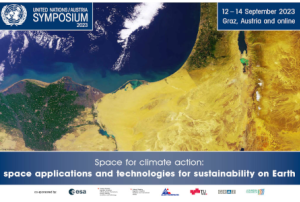
The 2023 UN/Austria Symposium "Space for climate action: space applications and technologies for sustainability on Earth" will take place in September 12 - 14 both on-site (Graz, Austria) and online.

This year's symposium, also the 29th edition of this series, will discuss the important contributions of space applications and technologies in tackling the challenges of climate change. The focus of the symposium is to showcase the most recent initiatives, experiences and best practices in mitigating and adapting to climate change and supporting sustainability on Earth. Further to creating awareness of how Member States use space technologies, the symposium will highlight how the space sector is being adapted to reduce its own impact on the climate crisis. The symposium would collect ideas and contributions to define future activities.

To raise awareness of relevant…

more

The 8th IAA Planetary Defense Conference programme is still under construction. However, the key topics will include: 

  • Ongoing and Upcoming Mission Highlights
  • Hypothetical Asteroid Threat Exercise
  • Key International and Policy Developments
  • Near-Earth Object (NEO) Discovery
  • Near-Earth Object (NEO) Characterization
  • Deflection / Disruption Modeling & Testing
  • Space Mission & Campaign Design
  • Impact Effects & Consequences
  • Disaster Management & Impact Response
  • Public Education and Communication
  • The Decision to Act: Political, Legal, Social and Economic Aspects

For more information on the programme check regularly IAA's website.  

Pre-registration for the event is now available…

more

The Committee on the Peaceful Uses of Outer Space (COPUOS) was set up by the General Assembly in 1959. Since its establishment, the Committee's membership has continued to expand. The Committee is the only committee of the General Assembly dealing exclusively with international cooperation in the peaceful uses of outer space, and its role as a forum to monitor and discuss developments related to the exploration and use of outer space has evolved alongside with the technical advancements in space exploration, geopolitical changes, and the evolving use of space science and technology for sustainable development.

The overall mandate of the Committee and its two Subcommittees aims at strengthening the international legal regime governing outer space, resulting in improved conditions for expanding international cooperation in the peaceful uses of outer space. The mandate also specifies that the Committee should supports efforts at the national, regional and global levels,…

more

The Regional Support Offices Meeting 2022 was conducted and organised by UN-SPIDER at the premises of the VIC in Vienna, from 14-16 November 2022. It was the first in-person meeting since the start of the COVID pandemic.  

The UN-SPIDER programme has 25 Regional Support Offices (RSOs) and two new candidates spread over different regions. These RSOs are engaged in supporting activities of UN-SPIDER such as technical advisory support, rapid mapping during emergency response, preparing specific publications and contents for the knowledge portal and contributing to the workshop and conferences.

Every year, UN-SPIDER organizes a meeting with the RSOs to discuss the progress and new activities. This meeting came after a three year in-person meeting hiatus, and was requested by most RSO representatives, with the aim to exchange on the status of more recent activities of RSOs, their contributions…

more

Objectives

At this first stakeholder meeting the Space4Water stakeholder community has an opportunity to get to meet and know each other in person. The workshop's objectives include the identification of

  • shared community objectives for the Space4Water community
  • approaches to assessing user needs within the community and water related sectors towards the space sector
  • approaches to facilitate matchmaking between users with needs and existing gaps and stakeholders who have solutions to (partial) problems


Dates and location

The workshop will take place on 27-28 October 2022 at the Vienna International Centre, with an opportunity to host it online, should COVID prevent travels in October.


Registration

To be considered for participation Space4Water stakeholders and featured professionals can register here. If your organisation…

more

The Committee on the Peaceful Uses of Outer Space (COPUOS) was set up by the General Assembly in 1959 to govern the exploration and use of space for the benefit of all humanity: for peace, security and development. The Committee was tasked with reviewing international cooperation in peaceful uses of outer space, studying space-related activities that could be undertaken by the United Nations, encouraging space research programmes, and studying legal problems arising from the exploration of outer space.

The Committee meets annually in Vienna, Austria, to discuss questions relating to current and future activities in space. Topics for discussion include maintaining outer space for peaceful purposes, safe operations in orbit, space debris, space weather, the threat from asteroids, the safe use of nuclear power in outer space, climate change, water management, global navigation satellite systems, and questions concerning space law and national space legislation.

The…

more

The International Society for Digital Earth (ISDE) is an international organisation created with the aim to promote international collaboration and knowledge exchange on the domain of Digital Earth. To achieve this goal, ISDE regularly convenes international symposia that bring together world-class scientists, engineers and educators engaged in the fields of digital earth, earth observation, geo-informatics and relevant applications. The theme of the 12th Symposium on Digital Earth (ISDE12) is "Digital Earth for Sustainable Societies". ISDE12 will aim to support the UN Sustainable Development Goals (SDGs) by harnessing the world’s data and information resources to digitally represent our planet, and to monitor, measure and forecast natural and human activities on Earth.

The annual EGU General Assembly is one of the largest and most prominent European geosciences event. It attracts over 14,000 scientists from all over the world, of which more than half are early career scientists.

The meeting’s sessions, typically over 500, cover a wide range of topics, including volcanology, planetary exploration, the Earth’s internal structure and atmosphere, climate, as well as energy and resources. Each annual General Assembly typically has around 4500 oral presentations, over 10,000 posters, and around 1000 PICO presentations.

The EGU General Assembly 2019, taking place in Vienna (Austria) on 7–12 April 2019, will bring together geoscientists from all over the world to one meeting covering all disciplines of the Earth, planetary, and space sciences. 

Session ESSI1.16 on "Earth Observations for Sustainable Development" will discuss how EO technologies can contribute to the delivery of sustainable, economic…

more

The Copernicus for Digital Earth Summer School 2019 is organized by University of Salzburg, Department of Geoinformatics (Z_GIS) – UNIGIS and CopHub.AC – co-organized by the European Association of Remote Sensing Laboratories (EARSeL), and supported by ESA and GEO and will be held in Salzburg, Austria, June 23 – July 4, 2019.

The vision of digital earth intends to help understand the Earth system by monitoring parameters and phenomena relevant to human society. The concept encompasses as an integral part advanced measuring technologies and transformations we are facing in their use, e.g. by the way how massive (‘big’) data, including satellite-borne data, are exploited and delivered in near real-…

more

From 23 to 25 April 2019, the GEO Data Technology Workshop will take place at the Vienna International Centre (VIC) in Vienna, Austria.

The workshop will focus on exploring how to most efficiently make available Earth observations-based knowledge for international policy frameworks, including the United Nations 2030 Agenda for Sustainable Development, the Sendai Framework on Disaster Risk Reduction and the Paris Climate Agreement.

Participants will be able to connect with and learn from international experts on data management, sharing and governance. They can particpate in discussions on a range of internationally-relevant issues, including the Global Earth Observation System of Systems (GEOSS), data governance and policy challenges, satellite-based and in situ Earth observation coordination, knowledge sharing, Earth observation platforms and analytics and more.

See the…

more