
Austria

country taxonomy block

The Committee on the Peaceful Uses of Outer Space (COPUOS) was set up by the General Assembly in 1959 to govern the exploration and use of space for the benefit of all humanity: for peace, security and development. The Committee was tasked with reviewing international cooperation in peaceful uses of outer space, studying space-related activities that could be undertaken by the United Nations, encouraging space research programmes, and studying legal problems arising from the exploration of outer space.

The Committee meets annually in Vienna, Austria, to discuss questions relating to current and future activities in space. Some topics for discussion include maintaining outer space for peaceful purposes, safe operations in orbit, space debris, space weather, the threat from asteroids, the safe use of nuclear power in outer space, climate change, water management, global navigation satellite systems, and questions concerning space law and national space legislation.

From 23 to 25 April 2019, the GEO Data Technology Workshop will take place at the Vienna International Centre (VIC) in Vienna, Austria.

The workshop will focus on exploring how to most efficiently make available Earth observations-based knowledge for international policy frameworks, including the United Nations 2030 Agenda for Sustainable Development, the Sendai Framework on Disaster Risk Reduction and the Paris Climate Agreement.

Participants will be able to connect with and learn from international experts on data management, sharing and governance. They can particpate in discussions on a range of internationally-relevant issues, including the Global Earth Observation System of Systems (GEOSS), data governance and policy challenges, satellite-based and in situ Earth observation coordination, knowledge sharing, Earth observation platforms and analytics and more.

See the...

more

Global warming, loss of biodiversity, food insecurity, pollution - the situation regarding the health of our planet is as serious as it is complex. Major global shocks have shown our vulnerability and set back the implementation of the Sustainable Development Goals. The global community noticed that our collective problem-solving mechanisms do not match the pace or scale of the challenges we face. Today's complex, interconnected, and rapidly changing world requires a more effective multilateral system and strong inclusion of effective innovative tools.

The Summit of the Future in 2024 was proposed as an opportunity to agree on multilateral solutions for a better future and to strengthen global governance for both present and future generations (A/RES/76/307). To prepare for the Summit, Member States asked the Secretary-General of the United Nations to come up with action-oriented recommendations, building on the proposals in his report, Our Common Agenda (A/75/982).

... more

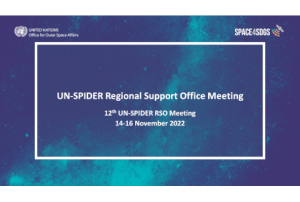
The Regional Support Offices Meeting 2022 was conducted and organised by UN-SPIDER at the premises of the VIC in Vienna, from 14-16 November 2022. It was the first in-person meeting since the start of the COVID pandemic.  

The UN-SPIDER programme has 25 Regional Support Offices (RSOs) and two new candidates spread over different regions. These RSOs are engaged in supporting activities of UN-SPIDER such as technical advisory support, rapid mapping during emergency response, preparing specific publications and contents for the knowledge portal and contributing to the workshop and conferences.

Every year, UN-SPIDER organizes a meeting with the RSOs to discuss the progress and new activities. This meeting came after a three year in-person meeting hiatus, and was requested by most RSO representatives, with the aim to exchange on the status of more recent activities of RSOs, their contributions...

more

The Committee on the Peaceful Uses of Outer Space (COPUOS) was set up by the General Assembly in 1959. Since its establishment, the Committee's membership has continued to expand. The Committee is the only committee of the General Assembly dealing exclusively with international cooperation in the peaceful uses of outer space, and its role as a forum to monitor and discuss developments related to the exploration and use of outer space has evolved alongside with the technical advancements in space exploration, geopolitical changes, and the evolving use of space science and technology for sustainable development.

The overall mandate of the Committee and its two Subcommittees aims at strengthening the international legal regime governing outer space, resulting in improved conditions for expanding international cooperation in the peaceful uses of outer space. The mandate also specifies that the Committee should supports efforts at the national, regional and global levels,...

more

The Copernicus for Digital Earth Summer School 2019 is organized by University of Salzburg, Department of Geoinformatics (Z_GIS) – UNIGIS and CopHub.AC – co-organized by the European Association of Remote Sensing Laboratories (EARSeL), and supported by ESA and GEO and will be held in Salzburg, Austria, June 23 – July 4, 2019.

The vision of digital earth intends to help understand the Earth system by monitoring parameters and phenomena relevant to human society. The concept encompasses as an integral part advanced measuring technologies and transformations we are facing in their use, e.g. by the way how massive (‘big’) data, including satellite-borne data, are exploited and delivered in near real-...

more

The Committee on the Peaceful Uses of Outer Space (COPUOS) was set up by the General Assembly in 1959. Since its establishment, the Committee's membership has continued to expand. The Committee is the only committee of the General Assembly dealing exclusively with international cooperation in the peaceful uses of outer space, and its role as a forum to monitor and discuss developments related to the exploration and use of outer space has evolved alongside with the technical advancements in space exploration, geopolitical changes, and the evolving use of space science and technology for sustainable development.

The overall mandate of the Committee and its two Subcommittees aims at strengthening the international legal regime governing outer space, resulting in improved conditions for expanding international cooperation in the peaceful uses of outer space. The mandate also specifies that the Committee should supports efforts at the national, regional and global levels,...

more

The Committee on the Peaceful Uses of Outer Space (COPUOS) was set up by the General Assembly in 1959 to govern the exploration and use of space for the benefit of all humanity: for peace, security and development. The Committee was tasked with reviewing international cooperation in peaceful uses of outer space, studying space-related activities that could be undertaken by the United Nations, encouraging space research programmes, and studying legal problems arising from the exploration of outer space.

The Committee meets annually in Vienna, Austria, to discuss questions relating to current and future activities in space. Topics for discussion include maintaining outer space for peaceful purposes, safe operations in orbit, space debris, space weather, the threat from asteroids, the safe use of nuclear power in outer space, climate change, water management, global navigation satellite systems, and questions concerning space law and national space legislation.

The...

more

The United Nations Office for Office for Outer Space Affairs has been organizing a series of workshops and conferences on space law and policy over a decade. This year, the Office will hold the United Nations Conference on Space Law and Policy from 19 to 20 November in Vienna, Austria.

Collaboration at both international and regional levels in the peaceful use of outer space is essential for ensuring that the advantages of space-based technologies are accessible to a broad spectrum of stakeholders, including governmental and non-governmental actors. Such cooperation also supports the expansion and diversification of national space initiatives. Sound policy and legal frameworks—developed and implemented at national, regional, and global levels—are fundamental to enabling countries, especially those still developing, to address sustainable development challenges and achieve their development priorities. As such, there is an ongoing need to reinforce the links between space law...

more

The Regional Support Offices Meeting 2023 was conducted and organised by UN-SPIDER at the premises of the VIC in Vienna. It was held back-to-back with the 66th Session of the Committee on the Peaceful Uses of Outer Space (COPUOS).

The UN-SPIDER programme currently has 27 Regional Support Offices (RSOs). These RSOs are engaged in supporting activities of UN-SPIDER such as technical advisory support, rapid mapping during emergency response, preparing specific publications and contents for the knowledge portal and contributing to the workshop and conferences.

Every year, UN-SPIDER organizes a meeting with the RSOs to discuss the progress and new activities.
At this year’s meeting, 10 RSOs joined the meeting in person, while 5 participated online. 2 candidates to become an RSO joined the meeting in person as guests....

more

Held every three years, the European Space Agency's (ESA) Living Planet Symposia are among the world’s leading events on Earth observation. The upcoming Living Planet Symposium 2025 (LPS25) will focus on the urgent need to transition from observation to climate action and sustainability in light of the growing climate crisis.

This five-day event will serve as a global forum for presenting and discussing the latest scientific advancements and applications based on satellite data. It will highlight the significant contributions that these technologies have already made, and can continue to make, in tackling environmental and societal challenges. The symposium will also showcase innovative products, services, missions, and initiatives aimed at demonstrating how space-based observations can benefit science, society, policymaking, businesses, and the economy alike.

LPS25 will bring together...

more